
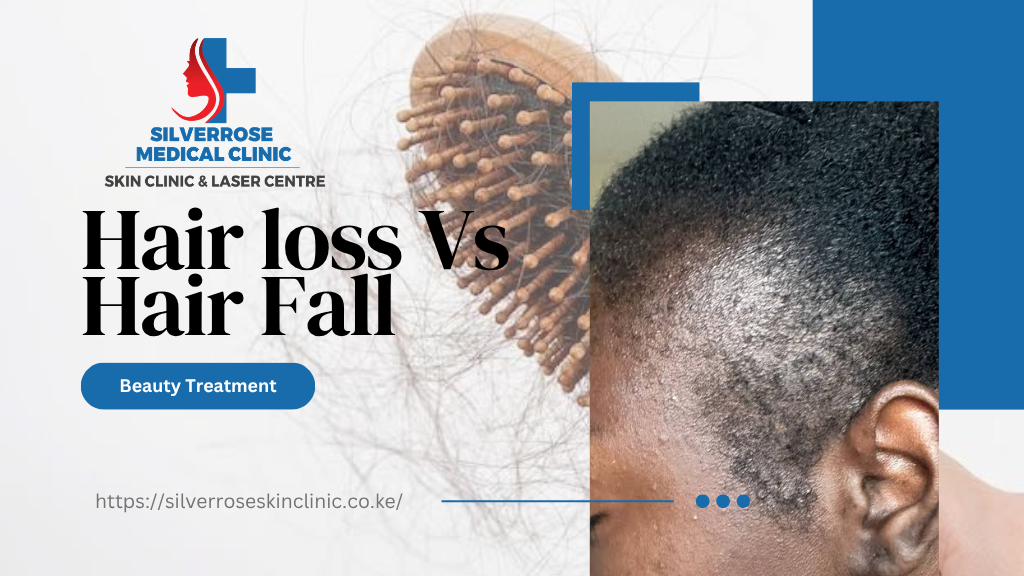
Confused about whether it’s hair loss in Kitengela or just normal hair fall?
Here’s the quick answer: hair fall is the everyday shedding your scalp does as part of its natural growth cycle, where you lose 50 to 100 strands a day.
Hair loss is different. It means hair isn’t growing back the way it should, leading to visible thinning, a receding hairline, or bald patches over time.
Everyone experiences hair fall. Not everyone experiences hair loss. Knowing which one you’re dealing with is the first step toward the right treatment, and it’s exactly the kind of question our dermatologist helps patients answer every week.
👉 Not sure which one applies to you? Book a scalp assessment with our team.
If you’ve read our guide on alopecia treatment in Kitengela, you already know that not all hair thinning is the same, and neither is the solution. This article goes one step further back, to the question we’re asked most often before diagnosis even comes up: “Is this normal hair fall, or is it something more serious?”
We’ll walk through exactly how to tell the difference, what causes each, and when it’s time to come in for a proper scalp check.
What Is Hair Fall?
Hair fall refers to the everyday shedding of hair as part of your scalp’s natural renewal cycle. Every hair follicle normally cycles through three phases: growth (anagen), transition (catagen), and rest/shedding (telogen). At any given time, roughly 10–15% of your hair is in the shedding phase, so losing some hair daily is completely expected.
Key characteristics of normal hair fall:
- ✦ Losing 50 to 100 strands per day is considered medically normal
- ✦ Hair falls out from the root, with a small white bulb visible at the tip
- ✦ New hair regrows in the same follicle within weeks to months
- ✦ Often tied to short-term triggers like stress, weather changes, or hormonal shifts
- ✦ Overall scalp density stays roughly the same over time
Think of it like leaves dropping off a tree in a season; it can look alarming when you notice it all at once, but the tree isn’t dying; rather, new growth usually follows.
What Is Hair Loss?
Hair loss, medically known as alopecia, is when hair doesn’t grow back at the same rate it falls out or stops growing altogether in certain areas. Over time, this leads to visible thinning, a receding hairline, or bald patches. It’s the same condition we cover in detail in our guide to alopecia treatment in Kitengela, where we break down the different alopecia types and how PRP therapy can help.
Key characteristics of hair loss:
- ✦ Shedding consistently exceeds 100–150 strands a day over weeks or months
- ✦ Scalp becomes visible through thinning hair
- ✦ Hairline recession or a widening part
- ✦ Patchy bald spots, sometimes smooth and round
- ✦ Hair becomes finer, shorter, or more brittle before growth stops
- ✦ It is often progressive and tends to worsen without treatment
Unlike hair fall, hair loss usually points to an underlying cause: genetics, hormonal imbalance, autoimmune activity, nutritional deficiency, or a scalp condition.
Hair Loss vs. Hair Fall: Side-by-Side Comparison
| Factor | Hair Fall | Hair Loss |
|---|---|---|
| Nature | Normal, cyclical process | Medical condition (alopecia) |
| Daily strand count | 50–100 strands/day | 150+ strands/day, or bald patches |
| Regrowth | Yes, hair regrows naturally | Often delayed, reduced, or absent |
| Duration | Temporary, self-resolving | Often chronic or progressive |
| Visible pattern | Even shedding, no bald spots | Receding hairline, widening part, patches |
| Common causes | Stress, weather, washing, styling | Genetics, hormones, autoimmune disease, medication |
| Needs treatment? | Usually not | Often yes, especially if progressive |
What Causes Hair Fall?
Hair fall is usually triggered by short-term, external, or lifestyle factors:
- ✦ Physical or emotional stress—a major life event can push more follicles into the shedding phase two to three months later, a condition called telogen effluvium
- ✦ Weather and seasonal changes
- ✦ Over-washing, heat styling, or harsh brushing
- ✦ Poor diet or crash dieting—temporary nutrient gaps like a low-protein diet or a diet heavy in refined sugar can affect the hair cycle
- ✦ Pregnancy and postpartum hormonal shifts
- ✦ Illness, fever, or recent surgery
Because these triggers are usually temporary, hair fall linked to them typically settles within three to six months once the underlying cause resolves.
What Causes Hair Loss?
Hair loss usually points to a more persistent, internal, or structural cause. As we cover more fully in our alopecia guide, the most common drivers include:
Genetic and Hormonal Factors
This includes hereditary pattern baldness (androgenetic alopecia) driven by genes and hormones like DHT, as well as hormonal shifts from thyroid issues, PCOS, and menopause.
Medical Conditions and Immune Response
This covers autoimmune conditions like alopecia areata, where the immune system mistakenly attacks hair follicles, as well as scalp infections and chronic illnesses.
Nutritional Deficiencies and Medications
This involves a lack of essential nutrients (like iron, zinc, or protein) and side effects from certain drugs, including chemotherapy, blood thinners, and antidepressants.
Physical Stress and Lifestyle Damage
Temporary hair loss, commonly known as telogen effluvium is triggered by extreme physical trauma or crash dieting. Traction alopecia, on the other hand, is caused by tight hairstyles pulling on the roots of the hair.
How to Tell If It’s Hair Fall or Hair Loss
You don’t need to guess. Here’s how to check at home:
- The 100-strand count. Track roughly how many strands you shed a day (shower, pillow, brush combined) for a week. If it consistently is over 100–150, it suggests hair loss, not hair fall.
- The pull test. Gently tug a small section of hair (20–30 strands) from different scalp areas. If more than 4–6 come out easily, it may indicate active hair loss.
- Check the pattern. If the pattern is even in nature, with all-over shedding, it usually means hair fall. Thinning at the crown, a receding hairline, or defined patches point to hair loss.
- Look at regrowth. Part your hair and check for short, fine “baby hairs” along the hairline. This is a sign that the follicles are still active and simply thinning, versus areas with no regrowth at all.
- Track the timeline. If shedding calms down after three to four months, it was likely hair fall. If it continues or worsens, it’s more likely hair loss.
If you’re unsure, this is exactly what a proper scalp assessment is for. At Silverrose, we use both a hands-on dermatologist evaluation and our AI scalp analysis, which captures high-resolution images of your scalp across seven parameters, including hair density, follicle health, and early miniaturization, to give you a clear answer instead of guesswork.
When Should You See a Dermatologist?
Book a consultation if you notice:
- ✦ Shedding that doesn’t improve after three to four months
- ✦ Visible thinning or a widening part
- ✦ Bald patches, especially smooth, round ones
- ✦ Scalp itching, redness, flaking, or pain alongside shedding
- ✦ Sudden, dramatic hair loss after starting a new medication
- ✦ A family history of pattern baldness combined with early thinning
Early diagnosis matters.
As we explain in our alopecia treatment guide, conditions like androgenetic alopecia respond far better to treatment when caught early, before follicles miniaturize permanently.
Treatment Options at Silverrose Skin Clinic
For hair fall, the goal is usually to remove the trigger and support the scalp:
- ✦ Gentle, sulfate-free hair care and reduced heat styling
- ✦ A balanced diet with adequate protein, iron, and biotin
- ✦ Stress management
- ✦ Scalp massage to support circulation
For hair loss, treatment depends on the diagnosed cause. At Silverrose, this typically starts with a consultation and AI scalp analysis to pinpoint the cause, followed by a personalized plan that may include:
- ✦ PRP hair therapy – using your own blood’s growth factors to stimulate weakened follicles, priced between KES 12,500 and 15,000 per session depending on the treatment area
- ✦ Prescription medications such as minoxidil
- ✦ Treatment of underlying hormonal or nutritional deficiencies
- ✦ Scarring alopecia and infection management where relevant
- ✦ Ongoing scalp monitoring to track density and follicle health over time
We combine both approaches with our broader personalized skincare and treatment philosophy, because your hair, like your skin, deserves a plan built around your specific diagnosis, not a generic routine.
Frequently Asked Questions
Is hair fall the same as hair loss?
No. Hair fall is the normal daily shedding of hair as part of the growth cycle, while hair loss is a condition where hair doesn’t grow back properly, leading to visible thinning or bald areas over time.
Can hair fall turn into hair loss?
Yes, if the underlying trigger isn’t addressed. Chronic stress, nutrient deficiencies, or an undiagnosed hormonal issue can push ongoing hair fall into a pattern of true hair loss over time.
Does hair grow back after hair fall?
Yes. Since hair fall is part of the natural growth cycle, the same follicle typically regrows hair within a few weeks to months.
Does hair grow back after hair loss?
It depends on the cause. Hair loss from temporary triggers, such as telogen effluvium or a nutrient deficiency, can often be reversed once treated. Genetic pattern hair loss and some autoimmune or scarring conditions may require ongoing treatment, such as PRP or minoxidil, and may not fully reverse. Our alopecia guide breaks down which types respond best to which treatment.
What’s the main difference between hair fall and hair thinning?
Hair fall refers to strands shedding from the scalp, while hair thinning refers to a reduction in hair density or diameter over time. Thinning is often a visible sign that hair fall has progressed into hair loss.
Not Sure Which One You’re Dealing With? Let’s Find Out Together
Whether you are experiencing hair fall or hair loss, the only way to know for certain is a proper scalp assessment.
At Silverrose Skin Clinic in Kitengela, our dermatology team combines hands-on clinical evaluation with AI scalp analysis to identify exactly what’s happening beneath the surface, then build a treatment plan around it, whether that’s simple scalp care or PRP hair therapy.
Book a consultation or message us on WhatsApp to get started.